Whitefly Treatment in a New Zealand Grow: Identifying It Early and What Actually Works
Royal King Seeds
Cultivation team
Whitefly is beaten by catching the first few adults on yellow sticky traps before they breed, then hitting the undersides of leaves with a contact spray — insecticidal soap, a light horticultural oil, or neem — every four to five days for three rounds, because one spray only kills the adults and crawlers, never the eggs or the armoured late-stage nymphs. If you are already shaking the plant and watching a white cloud lift off it, you are past early detection and into a four to six week campaign that will also need the soil, the vents and the weeds along the fence line dealt with.
The reason whitefly is such a persistent nuisance in New Zealand is climate, not carelessness. Greenhouse whitefly breeds year round in a warm Northland or Auckland glasshouse, and in a heated tent it never gets the winter knock-back that would reset the population outdoors. Add the tomatoes, the kūmara, the brassicas and the abutilon growing within twenty metres of most Kiwi back gardens, and there is always a reservoir waiting to move in.
How to tell whitefly from thrips, aphids and fungus gnats in thirty seconds
Three small flying pests show up on indoor cannabis in New Zealand and the treatment for each is different, so the identification matters more than the panic. Turn a leaf over and look at what is actually sitting there.
- Whitefly adults — two to three millimetres, pure white, wings held tent-like over the body, clustered on the undersides of the newest leaves near the top of the plant. Disturb the plant and they flutter up in a cloud, then settle straight back down.
- Fungus gnats — dark grey to black, long-legged, weak drifting flight, and they come off the soil surface, not the canopy. They do not cluster under leaves.
- Thrips — slender, tan or dark, two millimetres, they run rather than fly when you touch the leaf. Damage is silver stippling with black specks of frass.
- Aphids — pear-shaped, slow, do not fly at all in their common wingless form, and congregate on stems and growing tips rather than leaf undersides.
The clincher is the immature stage. Whitefly nymphs look nothing like the adults: flat, oval, translucent to pale green scales glued motionless to the underside of a leaf, about half a millimetre across, easily mistaken for part of the leaf surface. Under a loupe they have a faint fringe. Once you have seen them once you will never miss them again, and finding them is the proof that the adults you caught are breeding on your plants rather than wandering in from next door's tomatoes.
What whitefly actually does to a cannabis plant
Whitefly feeds on phloem sap through a stylet, which means the direct damage is slow. A light population on a vigorous vegetative plant causes very little you would notice. The problems arrive from three directions at once.
First, sheer numbers. A female lays eggs continuously, and in a warm tent the egg-to-adult cycle runs roughly three weeks, faster when temperatures sit in the high twenties. A dozen adults in week one becomes an infestation by week five, and the leaf drain finally shows as a dull, pale, flat-looking canopy with yellow mottling that does not respond to feeding.
Second, honeydew. Like aphids and scale, whitefly excretes sugar. It lands on the leaves below, turns sticky, and sooty mould colonises it — a black, dusty film that blocks light and is miserable to deal with on flowering heads. In a damp Bay of Plenty autumn, sticky buds and black mould are the start of a much larger problem, because the same conditions favour botrytis.
Third, and the one growers underrate, whitefly is a virus vector. Greenhouse whitefly is a less efficient vector than silverleaf whitefly, but moving insects between a tomato patch and a cannabis plant is never a good idea. If you grow both, treat them as one shared pest population.
Yellow sticky traps are monitoring equipment, not a control
Hang them before you have a problem. Yellow cards at canopy height, one every square metre or so, tell you three things no amount of staring at leaves will: whether adults are present at all, whether the number is rising or falling week to week, and whether they are arriving through a vent or hatching inside the tent.
Count them. Write the number and the date on the card with a marker. A card that goes from three adults to twelve in a week is a breeding population inside the room. A card near the intake that catches twenty while the cards deeper in the room catch two is an ingress problem — fit finer intake filtering and stop spraying the plants.
Traps will never clear an infestation on their own. They catch adults, and adults are the fraction of the population you can most easily kill by other means. The eggs and nymphs welded to the leaf undersides are unaffected, which is exactly why a trap-only approach plateaus and then loses ground.
Where to look first on the plant
- Undersides of the three or four newest fully expanded fan leaves — adults prefer young tissue.
- Leaves immediately below those, for the flat oval nymphs and spent white pupal cases.
- The inner canopy where air is still, especially if you run a dense untrained plant.
- Any plant sitting closest to a vent, door or window.
- Ornamentals and vegetables in the same room or greenhouse — fuchsia, abutilon, tomato and cucumber are classic hosts.
The spray schedule that actually clears them
Whitefly is not killed by one application of anything, because the life stages are not all vulnerable at the same moment. Eggs are protected. Late-stage nymphs develop a waxy covering that sheds most contact sprays. Only adults, young crawlers and freshly laid eggs sit exposed. So the interval between sprays is the whole strategy: you spray, wait for the protected stages to hatch or emerge into vulnerability, then spray again before any of them can lay.
A workable rotation for a home grow:
- Day 0 — insecticidal soap or potassium salts of fatty acids, mixed to the label rate, sprayed until the leaf undersides are running wet. Lights off, or late in the day outdoors.
- Day 4 — repeat. This catches the crawlers that hatched from eggs laid before the first spray.
- Day 8 — light horticultural oil or neem at label rate, which smothers and also disrupts the moult. Rotating the mode of action matters.
- Day 12 — repeat the soap. Re-count your sticky traps at this point. A falling count means you are winning.
- Day 16-20 — one further round if trap counts are still above zero.
Coverage is more important than product choice. Ninety percent of a whitefly population is on the underside of leaves, and a sprayer pointed down at the canopy from above wets almost none of it. Use a hand sprayer with an adjustable nozzle, get under the plant, and work upwards. Bend branches gently to expose the undersides. It takes three times longer than you think it should, and the growers who fail are almost always the ones who sprayed the tops.
Two cautions. Do not spray oil or soap onto plants in direct sunlight or with the lights on — leaf burn is close to guaranteed. And stop all foliar spraying well before harvest; once bracts have swollen and trichomes are mature, wetting the heads invites botrytis and leaves residue that will never fully dry out of a dense flower. If whitefly arrives in late flower, your remaining tools are traps, airflow and defoliation of the worst leaves, not spray.
Biological control works, but only if you start it early
Encarsia formosa is the standard parasitic wasp for greenhouse whitefly and is available through horticultural suppliers in New Zealand. It is a genuinely effective tool in a glasshouse, where the warm stable conditions suit it. The wasp lays into whitefly nymphs, which turn black as the parasite develops — seeing black scales on the leaf undersides is the sign it is working.
Two conditions decide whether it is worth your money. The wasp needs consistent temperatures above roughly 18 degrees Celsius and good light levels to stay active, which rules out an unheated shed over a Canterbury spring. And it cannot be combined with the spray schedule above, because soap and oil kill the wasps as readily as the whitefly. You pick one approach, not both.
In practice, biologicals suit a greenhouse grower in Northland or the Bay of Plenty who detected the problem at a handful of adults and has time on their side. A grower who already has clouds lifting off the canopy should knock the numbers down with sprays first, wait a fortnight for residues to clear, then release. Predatory mites and Macrolophus also have a role commercially, but for a home-scale grow the wasp is the realistic option.

Why outdoor whitefly in New Zealand is a different problem
Outdoors you are not managing a closed population, you are managing immigration. Whitefly moves in from whatever is growing nearby, and in most New Zealand back gardens that means the vegetable patch. Clearing a two-metre buffer of weeds, pulling spent tomato plants at the end of the season instead of leaving them standing, and not planting cannabis downwind of a cucumber frame all do more than any spray.
Weather does the rest. Heavy rain physically knocks adults off the plant, which is why coastal Taranaki and the West Coast rarely see the sustained pressure that a sheltered Auckland glasshouse does. Wind does the same — the Canterbury nor'wester is hard on a lot of things, but whitefly is not fond of it either. The places that get a real outdoor whitefly problem are warm, sheltered and humid: north-facing suburban corners around Auckland, Tauranga and Whangārei, with a fence on the windward side and tomatoes next door.
The timing argument is the important one. Whitefly pressure builds through summer and peaks in February and March, which in New Zealand is exactly when outdoor plants are putting on flower. A variety that finishes early takes its buds out of the firing line before the population has reached its worst, and the same early finish is the main defence against the damp-autumn botrytis risk. Those two reasons point the same way, which is why short-season genetics are the single most useful decision an outdoor grower here makes.
If you are mapping that out, the month-by-month shape of the season is worth having in front of you.
Timings shift with latitude — the north runs earlier and longer than inland Otago and Southland.
Early-finishing feminised varieties are the practical answer to a February pest peak, and these are the three most commonly chosen for it.
Flowering windows vary by phenotype and by how early you got the plant outside, so check the published flowering range on the Early Girl Feminised genetics report rather than working off a generic estimate. The same figures for the whole short-season group are set out across the outdoor-suited cultivar range.
Tent hygiene is the cheapest treatment there is
Indoors, almost every whitefly outbreak traces to one of four entry points, and all four are cheap to close.
- Unfiltered passive intake. A bare intake port is an open door. Fit insect mesh — the fine grade sold for greenhouse vents, not flyscreen — and accept the small loss in airflow.
- Clothing. Adults ride in on a shirt after an afternoon in the vegetable garden. Change before you go in the tent, or at least do not go straight from the tomatoes to the plants.
- Incoming plants. Anything brought in from outside, or from another grower, sits in quarantine for a fortnight with a sticky trap beside it. This includes houseplants moved into the same room.
- Standing host material. A dead leaf layer on the floor and old root balls left in the corner keep a population alive between crops.
Between grows, strip the tent out completely, wipe the interior with a detergent solution, and leave it empty and dry for a few days. A whitefly population cannot survive an empty tent, but it will happily survive on two forgotten seedlings in a corner tray.
Airflow matters more than most growers expect. Whitefly adults are weak fliers and dislike moving air; a good oscillating fan through the canopy both discourages settling and dries honeydew before sooty mould establishes. It also reduces the still, humid pockets that cause so many other problems in a dense indoor canopy.
Plant structure changes how bad an infestation gets
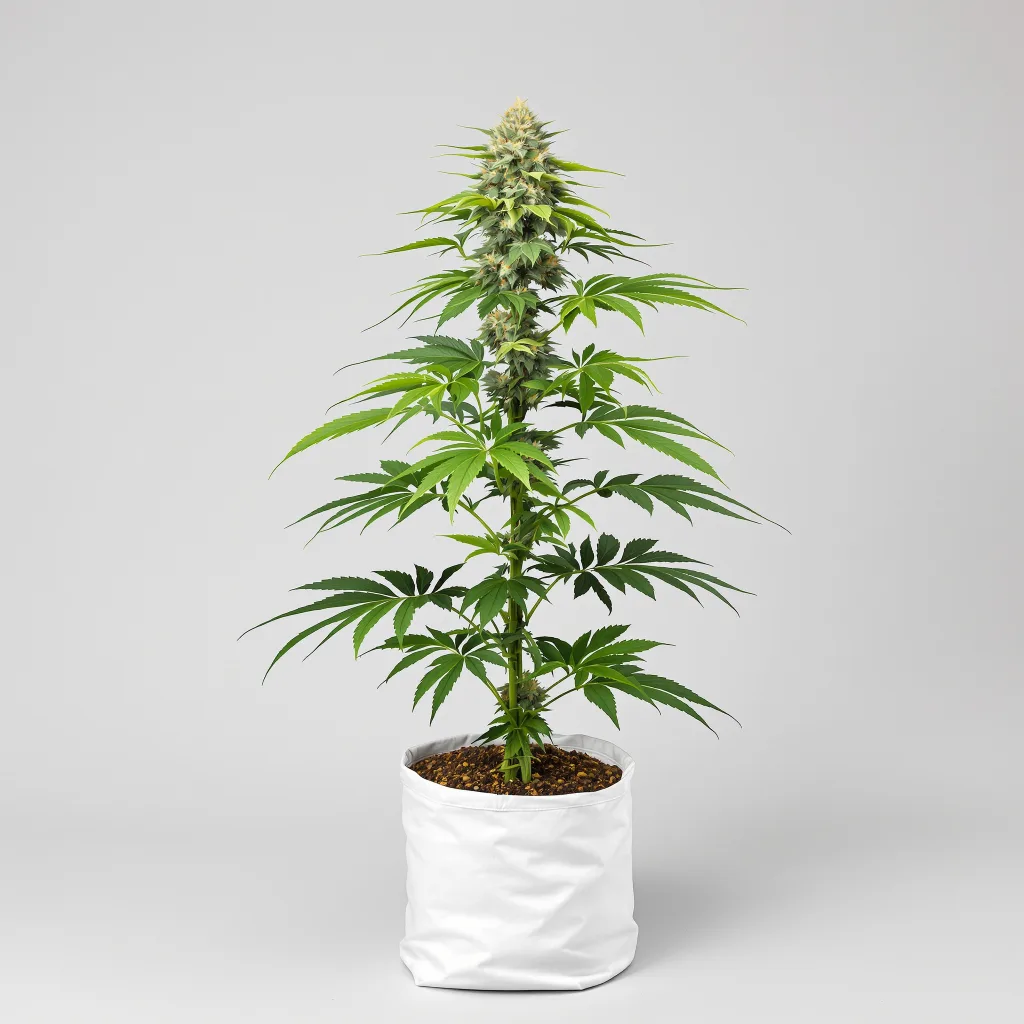
You cannot buy a whitefly-proof cannabis seed, and anybody selling one is lying. What you can choose is a plant structure that is easier to inspect and easier to spray. A dense, tight, broad-leafed indica with a packed inner canopy hides nymphs beautifully and keeps the air still around them. An open, airier plant with more internodal space lets you see leaf undersides without dismantling the plant and lets a sprayer reach them.
Training does the rest. Topping and spreading a plant across a horizontal plane, rather than letting it build a dense column, gives you access to every leaf underside from below. The same open structure is the standard defence against botrytis in a damp New Zealand autumn, so the effort pays twice. Removing the lowest, oldest, most shaded leaves — the ones that contribute least and host the most — is worth doing routinely rather than as a crisis response.
When you are weighing two candidates for an outdoor spot that you already know gets whitefly pressure, structure and finishing time are the two columns that matter most.
| Early Skunk Feminised | Early Miss Feminised | |
|---|---|---|
| Type | Photoperiod | Photoperiod |
| Lean | Indica | Hybrid |
| Listed THC | 21% | 21% |
| Flowering | 55-65 days | 50-60 days |
| Height | over 2 m | 90-120 cm. Medium |
| Indoor yield | Up to 500g/m² | up to 200 g/m2 |
| Outdoor yield | Up to 600 gr | up to 115 g/plant |
| Difficulty | Easy | Easy |
| Price from | $26.09 | $19.79 |
Both lean toward manageable outdoor plants rather than towering ones, and the full breakdown for the skunk side sits on the Early Skunk Feminised genetics report. If you are matching a variety to a specific region and site rather than browsing, the strain finder tool narrows it by finishing time and growing conditions.
What does not work, and why growers keep trying it
Sticky traps alone plateau, for the reason already given. Beyond that, a handful of popular tactics waste time.
Single heavy sprays. People reach for a stronger product and apply it once, hard. The eggs survive, the protected nymphs survive, and ten days later the population is back with the added benefit of selection pressure toward resistance. Interval beats intensity, every time.
Vacuuming the canopy. It genuinely removes adults, and it is briefly satisfying, but it does nothing to the nymphs and the adults are the replaceable stage. As a one-off knockdown before the first spray it is defensible. As a strategy it is theatre.
Companion planting as a cure. Marigolds and basil may influence where adults choose to settle at the margins. They will not clear an established population off a plant that whitefly is already breeding on, and relying on them while the numbers build costs you the early window that actually decides the outcome.
Soil drenches. These are the right answer for fungus gnats and the wrong one for whitefly, which lives entirely on foliage. Treating the medium makes no difference to a leaf-underside pest. If you are unsure which of the two you have, go back to the identification list at the top — the answer changes everything you do next.
Frequently asked questions
Can I still smoke buds from a plant that had whitefly?
Whitefly itself leaves no residue in the flower, but honeydew and the sooty mould that grows on it do contaminate buds, and mouldy material should never be dried and kept. Inspect heads closely at harvest, discard anything with a black film, and be realistic — if the sooty mould has reached the colas rather than just the fan leaves, the affected heads are not worth saving.
How long does it take to get rid of whitefly completely?
Plan on four to six weeks from the first spray to zero trap catches, assuming you spray every four to five days and get good coverage on leaf undersides. A caught-early population on a single plant can be cleared in two to three weeks. If you are still catching adults after six weeks, you have an ingress problem or an untreated host plant somewhere nearby, not a spray-failure problem.
Is neem safe to use on flowering cannabis?
Use it in vegetative growth and early flower only. Once bracts swell and the heads tighten, any foliar spray leaves moisture sitting inside dense flower where it cannot evaporate, and in a humid New Zealand autumn that is an invitation to botrytis. Neem also leaves a taste and a residue that the cure will not remove.
Does whitefly survive a New Zealand winter outdoors?
Greenhouse whitefly does not overwinter well outdoors in the colder parts of the South Island, where hard frosts from April inland in Canterbury, Otago and Southland knock it right back. In the warm, frost-free north it persists on weeds and garden hosts year round, which is why Auckland and Northland growers face a population already established at the start of the spring season rather than one that has to re-establish.
Should I just start over if the plant is badly infested?
In vegetative growth, with one or two heavily infested plants and a clean tent otherwise, scrapping them and resetting is often faster and cheaper than six weeks of spraying. In flower it rarely makes sense, since you are usually a few weeks from a harvest that is still worth having. Either way, clean the space out properly before the next run — details on seed handling and replacement are covered in the growing and ordering FAQ, and the full catalogue sits under feminised seed varieties.
Related Articles
Bud Rot: Why a Damp New Zealand Autumn Is When It Takes Hold, and the Plant Traits That Resist It
pests-and-problemsThrips Damage in a New Zealand Grow: Reading the Leaf and Stopping the Spread
pests-and-problemsThrips NZ: Identifying Them Early and What Actually Works
pests-and-problemsFungus Gnats NZ: Identifying Them Early and What Actually Works
Ready to Start Growing?
All 1,677 varieties, posted unbranded and tracked to both islands, each with whatever grow figures we could trace.
Shop Cannabis Seeds